
IRANZ news briefs
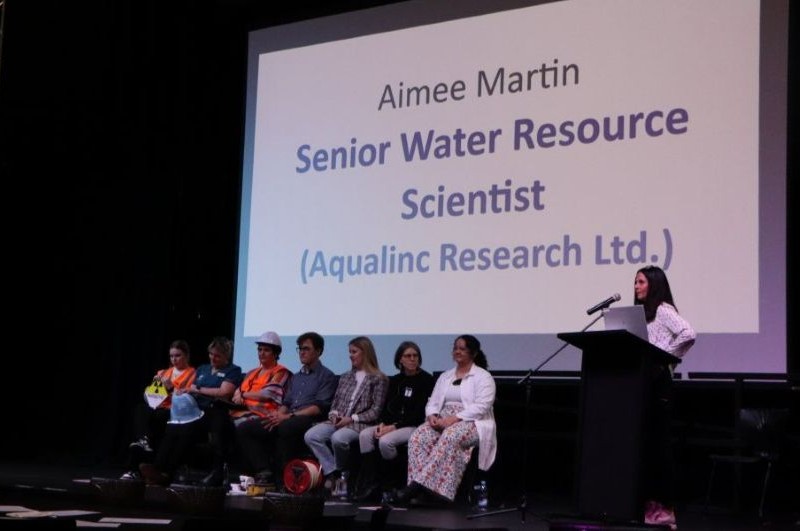
Aimee Martin, a Senior Water Resource Scientist at Aqualinc Research, recently attended an Inspiring the Future event at Rolleston College and was involved in a 'guess my job' event with Year 9 & 10 students. "They guessed I was a solar panel engineer, an arborist, and an environmental scientist - so close." Photo: Aqualinc.
Aqualinc: Inspiring the Future Aotearoa
Aimee Martin, a Senior Water Resource Scientist at Aqualinc Research, recently took part in an Inspiring the Future event at Rolleston College, introducing Year 9 and 10 students to her career and answering questions from senior students about working in science.
During a 'guess my job' activity, students suggested she might be a solar panel engineer, an arborist or an environmental scientist. A pizza lunch with Year 11 and 12 students provided an opportunity to discuss science careers and the paths into them.
Aimee found the experience rewarding, particularly when students recognised a water-level dipper she had used at their school. She hopes the event will inspire the next generation of scientists and water experts, noting that she had not known her own career existed when she was at high school.
Inspiring the Future is a programme for schools across Aotearoa New Zealand that broadens young people's horizons, challenges career stereotypes and introduces them to different jobs and the people who do them.
Mackie Research: Hamish Mackie awarded fellow from HFESNZ
Hamish Mackie has been awarded fellow professional membership of the Human Factors and Ergonomics Society of New Zealand (HFESNZ) following a rigorous assessment process. He is one of only two people in New Zealand to currently hold this distinction.
HFESNZ is the professional body supporting human factors and ergonomics practitioners in New Zealand. Founded in 1966, the society is based on the equivalent UK organisation.
Human factors research examines what constrains or promotes optimal human performance, considering people's abilities, characteristics and limitations alongside the design of the equipment, environments, tasks and systems they use.
BRANZ: Cutting through timber treatment myths
A pink tint, a high number or a mouldy wall does not necessarily indicate how well timber has been treated or whether the treatment is appropriate for its intended use.
BRANZ materials scientist Dr Kathryn Stokes explores common misconceptions about timber treatments, including the assumption that a higher hazard class automatically provides better protection.
Timber hazard classes, ranging from H1.1 to H6, specify the conditions a treatment is designed to protect against, rather than the level of protection it provides. For example, H6 treatment protects timber piles in the ground against severe decay hazards, whereas H1.2 is suitable for wall framing inside a house. Using H6 timber for an internal wall frame does not make it better suited to the job.
The key is to select the hazard class that matches the timber's intended use and exposure conditions.
Bragato: From Montpellier to Marlborough - introducing Matheo Boison
New Zealand's wine industry continues to benefit from international talent, bringing fresh thinking and global experience to vineyards and wineries. One of the latest additions to Marlborough's wine community is Matheo Boison, the new Viticulture & Winery Technical Specialist at Bragato Research Institute.
Raised in Brittany, a region of France not traditionally associated with wine production, Matheo grew up in a rural environment and developed an early interest in cultivation and agriculture. As he got older, he discovered wine and decided to combine his two passions through his studies and career.
Dragonfly Data Science: Zoey makes New Zealand home
Dragonfly Data Science's Zoey Sun has made her home in Aotearoa official, receiving New Zealand residency after initially arriving to complete her PhD.
Zoey originally planned to return to China and become a university professor, but her plans changed after spending time in New Zealand and seeing friends remain here after their PhDs.
As her PhD in deep learning and forestry research neared completion, she gained work experience through internships, including one with Callaghan Innovation. She subsequently joined Dragonfly Data Science, where she has spent the past year working on the forestry and remote sensing team.
Lincoln Agritech: From Sky to Soil
Seventy people from across New Zealand's innovation ecosystem recently gathered in Christchurch for Sky to Soil, an event hosted by Lincoln Agritech and the NZ Product Accelerator.
Researchers, farmers, growers, technology providers, regulators and innovators came together to explore how the adoption of aerial data in agriculture could be accelerated.
Discussions examined how aerial sensing technologies can turn data into better on-farm decisions, improving productivity while supporting more sustainable land management. Participants identified barriers to adoption, practical solutions and immediate actions to unlock greater value from aerial technologies.
Lincoln Agritech's Insights Report highlights a key message from the event: accelerating adoption is not simply about generating more aerial data, but about translating it into practical outcomes through collaboration, capability and farmer-led innovation.
Malaghan: New clinical research core to help take research from benchtop to bedside
The Malaghan Institute has established a new clinical research platform to help scientists translate their laboratory research into clinical studies and trials.
The clinical research core brings together staff with expertise in running human clinical studies and trials and working with human ethics committees. Previously, individual laboratory groups relied on the knowledge and experience within their own teams to advance research towards clinical applications.
Led by Brittany Lavender, the new core will provide consistent knowledge, advice and support to researchers across the institute whose work could eventually be used in a clinical study or trial.
The initiative aims to make clinical research more efficient and aligned with best practice, supporting the institute's strategic goal of delivering world-class transformative science.
Urban Intelligence: The cost of sea-level rise in Australia - new national study
A new study published in Scientific Reports provides the first nationally consistent assessment of the physical exposure and direct financial consequences of sea-level rise and storm surge across Australia.
Researchers Tom Kompas, Tuong Nhu Che, and Quentin Grafton assessed impacts across 1,156 coastal Statistical Area Level 2 (SA2) regions, combining projected inundation with property values and ten land-use categories.
Under the moderate-emissions RCP4.5 pathway, the study projects that 267,500 properties and two million hectares of land could be affected by 2100, with present-value damages of $855.1 billion. Under the high-emissions RCP8.5 pathway, the figures rise to 719,600 properties, 3.7 million hectares and $1.91 trillion in damages.
The modelling also estimates average annual damages equivalent to around 1.05-1.39% of Australian GDP under RCP4.5 and 2.26-3.02% under RCP8.5 across the sensitivity cases. By breaking down impacts by state, region and land-use category, the study reveals how local elevation, land use and property values shape the financial consequences of sea-level rise.
Bragato: Introducing winemaker Francesca Cavasin
Marlborough Sauvignon blanc inspired Francesca Cavasin to pursue a career in wine, setting her on a path that has taken her from vineyard work in New Zealand to wine studies in Conegliano, Italy, where Romeo Bragato once studied. Her career has now come full circle with her role as Research Winemaker at Bragato Research Institute.
Francesca grew up in the province of Treviso in northern Italy, where her parents owned a plant and flower nursery and grew Radicchio di Treviso, a traditional local vegetable, as well as kiwifruit.
Growing up surrounded by plants and agriculture gave Francesca an early understanding of how plants grow, laying the groundwork for her later career in wine research.
Lincoln Agritech: New field guide helps improve spreading accuracy for blended fertilisers
A new field guide developed through Ministry for Primary Industries-funded research will help farmers and contractors improve the accuracy of blended fertiliser spreading, with trials showing that relatively simple changes can significantly improve application uniformity.
How to Spread Blended Fertiliser - A Field Guide was developed through the Sustainable Food and Fibre Futures-funded project Reducing Off-Target Fertiliser Application. It translates research findings into practical advice for everyday spreading operations.
The guide supports the internationally recognised 4R nutrient stewardship principles: applying the right product, at the right rate, in the right place and at the right time.
Ag Emissions Centre and AgriZero: Novel approaches to measure and reduce agricultural emissions sought
The Ag Emissions Centre and AgriZero are seeking innovative approaches to agricultural emissions measurement and reduction that offer a credible pathway to adoption and impact within New Zealand's pastoral systems.
The 2026 Innovation Investment Round, Round 2, offers two funding pathways. Full research and development proposals can seek a share of NZ$2 million for projects lasting up to two years, with collaboration encouraged and co-funding strongly supported. Early-stage R&D Ideas can receive up to NZ$50,000 per project for work lasting up to six months to assess feasibility.
The organisations are particularly interested in proposals from researchers and technical specialists working in soil science, microbiology, biological technologies, emissions measurement, engineering and related disciplines.
Expressions of interest close on 18 November 2026.
Date posted: 28 October 2026