
IRANZ news briefs
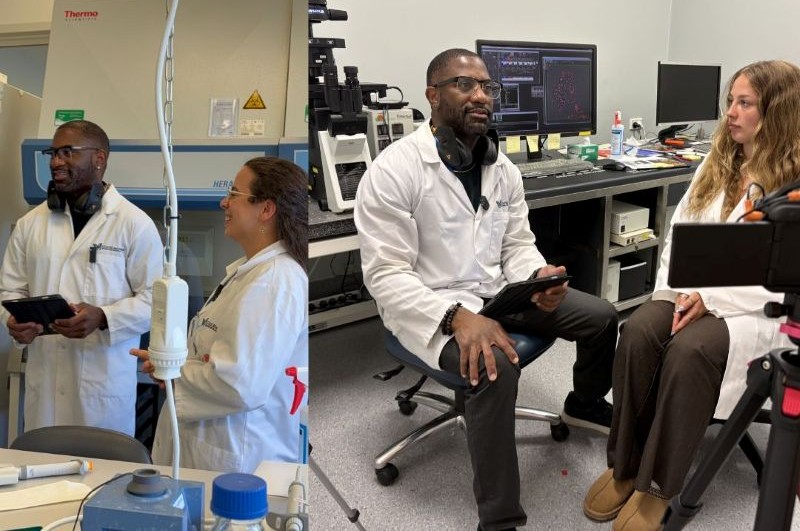
The Gillies McIndoe Research Institute has announced a new collaboration with Hip Hop Science, led by internationally recognised science communicator and author Maynard Okereke. Photo: Gillies McIndoe.
A new chapter - the next generation of BRANZ scientists
The future of building science is in good hands. Meet some of the next generation of BRANZ scientists who are driving innovation and research excellence - ensuring our expertise shapes tomorrow's built environment.
Meet Jarred, Amy, Ryan, and Griffin - just a handful of scientists bringing their skills and commitment to BRANZ. The projects they are working on will help drive understanding of building science into the future.
Cawthron: Inaugural Ring Science Scholarship recipients announced during Seaweek celebrations
Two rising stars in science, Freya High and Jasmin Malcolm, have been named the inaugural recipients of the Ring Science Scholarships, made possible through a generous bequest from Jim and Fleur Ring to Cawthron Institute. The scholarships support students pursuing freshwater or marine science studies.
Cawthron is pleased to announce the scholarship recipients during Seaweek, a nationwide, collaborative, community-led initiative that celebrates the wonders of the ocean and highlights the many ways people and the marine environment are connected.
Freya is studying for a Bachelor of Science, majoring in geology and biology, at the University of Canterbury. Adventuring in the mountains, rivers and oceans of Whakatū Nelson while growing up inspired her to better understand the challenges facing our environment and the connections between people and the Earth.
Jasmin is studying towards a Bachelor of Science, majoring in marine biology, at Te Herenga Waka - Victoria University of Wellington. Spending her childhood in Te Tauihu also shaped her love for nature and the ocean. As a Year 13 student, she took part in Cawthron's Mussel Biology Workshops, learning about the importance of science for the aquaculture industry.
Lincoln Agritech-led research highlights pressure on Waikato River system
A senior scientist from Lincoln Agritech has highlighted growing concerns about the health of the Waikato River, as multiple environmental pressures push the system towards critical tipping points.
In an article by journalist Matthew Martin in the Waikato Times, Dr Adam Hartland warns that the river is "becoming a case study in what happens when very different environmental pressures hit the same system faster than authorities can respond". Adam, an Adjunct Associate Professor at Lincoln University and a Hamilton-based senior scientist, points to real-time sensor data showing the system is approaching thresholds "we do not want to cross".
The research forms part of a five-year, Ministry of Business, Innovation and Employment (MBIE)-funded programme led by Lincoln Agritech. The programme is advancing understanding of cumulative stressors on river systems, supporting more informed management to help protect the long-term health and resilience of the Waikato River.
HERA: Acknowledging Dr Troy Coyle, former Chief Executive Officer
Dr Troy Coyle concluded her tenure as HERA's Chief Executive on 31 March 2026. The HERA Board and its wider membership acknowledge the significant contribution she made to HERA and to the industries they serve.
"During her time as CEO, Troy provided clear strategic direction across a period of genuine growth and change. Under her leadership, HERA expanded into new areas including AI, Construction 4.0, structural health monitoring, bridge design, and structural fire engineering; strengthening both our capability and our influence across the sector. Her focus on financial sustainability, technical excellence, and industry collaboration leaves the organisation in a stronger position than she found it.
"A defining milestone of Troy's tenure was the development of the HERA Innovation Centre. Now progressing toward an anticipated opening in mid-2026, the centre reflects years of sustained effort and a commitment to world-class research, collaboration, and low-carbon transformation."
Global science communicator partners with Gillies McIndoe to broaden research reach
The Gillies McIndoe Research Institute has announced a new collaboration with Hip Hop Science, led by internationally recognised science communicator and author Maynard Okereke.
Known for making complex science accessible to wide audiences, Hip Hop Science brings a global platform to showcase the Institute's research and connect with new communities. During his visit, Maynard engaged with PhD students, discussing a range of often misunderstood health topics.
Conversations explored the differences between common birthmarks, including infantile haemangiomas (benign tumours sometimes referred to as "strawberry birthmarks"), as well as why conditions such as meningioma remain relatively unknown despite being among the most common brain tumours. Discussions also covered advances in treating keloid scars and the challenges of aggressive cancers such as glioblastoma, alongside a patient interview offering a personal perspective on living with the disease.
By combining scientific expertise with real-world stories, the partnership aims to make research more relatable and accessible, helping to bridge the gap between science and the wider public.
Follow along and watch the conversations unfold:
Facebook: https://www.facebook.com/GMRI
Instagram: https://www.instagram.com/gilliesmcindoe
Malaghan: From clinical trial to clinical tool
Dr Philip George has been a part of New Zealand's CAR T-cell journey from the beginning, helping establish the ENABLE phase 1 trial, and now helping lead its phase 2 successor.
Having trained in the United Kingdom, where CAR T-cell therapy is standard of care for certain blood cancers, Phil is determined that New Zealanders gain access to the same life-changing technology here at home.
Clinical breakthroughs do not happen overnight; an enormous amount of work takes place behind the scenes. Scientists spend years refining and testing new cancer therapies, carefully building treatments that one day may change a patient's life. The journey from scientific discovery to treating a patient is rarely rapid.
In 2018, midway through his specialist training in haematology at the University Hospitals of Leicester in the United Kingdom, Phil was looking for an opportunity to gain experience in clinical research. Through a mutual connection he was introduced to Professor Robert Weinkove, Clinical Director at the Malaghan Institute and leader of the CAR T-cell programme.
Phil was soon recruited for a clinical research fellowship at the Malaghan Institute, flying halfway around the world to help establish New Zealand's first CAR-T trial.
Mātai: New building now two years old
Mātai Medical Research Institute opened the doors on their new building two years ago - a moment that has stayed with them.
"We'll never forget how our Mātai whānau, iwi, collaborators, supporters, and wider community came together to help us open our whāre.
"Since then, this space has been filled with connection and discovery - grounded in the people who bring it to life: our Mātai whānau, tamariki, rangatahi, pakeke, research participants and their whānau, clinical patients, referrers and healthcare partners, scientists and research fellows, entrepreneurs, TŌNUI Collab, funders, academic and community partnering organisations, interns, international guests, the unexpected visitors who pop in just to say hello, and our fur babies a.k.a. Head of Morale.
"Ngā mihi nui to everyone who stood with us then and continues to walk alongside us now, and to those who have joined the waka along the way."
Motu Research challenges inclusion on register alongside lobbying organisations
Motu Research has formally requested removal from the Democracy Project's NZ Lobbying and Influence register, asserting that inclusion misrepresents the organisation's role and mission.
Motu Research is a charitable trust and a leading independent economic research institute in Aotearoa New Zealand, conducting rigorous analysis without advocating specific ideologies or political positions. Founded on the principle that sound public policy requires evidence-based research and informed debate, Motu maintains strict independence from political and commercial interests.
"We believe strongly in the distinction between independent research and advocacy," says Motu's Executive Director, Dr John McDermott CRSNZ. "Our mission centres on producing objective analysis to inform public discourse, not influencing specific policy outcomes."
The Democracy Project's register lists organisations that allegedly engage in lobbying or wield influence over New Zealand's political landscape. Project coordinator Bryce Edwards acknowledges Motu differs from traditional lobbying entities but maintains the organisation belongs on a broader list of influential think tanks and institutions.
LASRA: Science that stays with the problem
Geoff Holmes, Director of the Leather and Shoe Research Association (LASRA), says science is often framed as a pipeline from discovery to impact, but in practice it behaves as an iterative process shaped by context and use.
He argues the real challenge is less the "lab-to-market gap" and more the space between knowledge and use, capability and adoption, and invention and integration. In materials and manufacturing, outcomes are shaped by process constraints, scale, variability, and workforce capability. Value emerges when ideas survive contact with real-world conditions.
The often-overlooked middle phase, where materials are validated, processes stabilised, and trust is built, determines whether innovations take hold or fade away. Using leather as an example, he notes performance is not simply transferred but built through repeated biological, chemical, and mechanical decisions.
Impact is cumulative, seen in more consistent materials, reliable processes, and longer-lasting products. The key question is not how much science is produced, but how long it is carried forward so it can matter in practice.
Two new trustees join Cawthron Institute's Trust Board
Dr Allan Freeth and Tom Williams have been appointed as Trustees on the Cawthron Institute Trust Board. Both bring considerable skills and experience and will contribute to Cawthron's continued success.
Malaghan: Award celebrates international collaboration that sparked landmark cancer discovery
Long-time collaborator Professor Jiri Neuzil has been presented with a Distinguished Collaborative Research Fellow Award by the Malaghan Institute, honouring an international collaboration that sparked a new field of cancer biology.
Director Professor Kjesten Wiig says the award - the first of its kind - recognises the importance of collaboration in fundamental research in driving discoveries that advance human health.
It has been more than a decade since Professor Mike Berridge and Professor Neuzil made the ground-breaking discovery that mitochondria can travel between healthy and cancerous cells. Known as horizontal mitochondrial transfer, the discovery has had far-reaching implications in cancer research and cell biology and sparked a decades-long collaboration between the researchers.
Motu researcher Livvy Mitchell elevates dialogue on youth adversity
When a young person experiences serious adversity — such as suicide or violent crime — the impacts extend beyond the individual, affecting families and communities through lost income, poorer health, and reduced life chances.
Livvy Mitchell, a researcher at Motu, is bringing these previously under-recognised impacts into focus on the world stage. She recently completed her PhD in Economics at Auckland University of Technology.
Her thesis, The Ripple Effect of Youth Adversity: Economic and Health Impacts on Families, examines how events such as youth suicide and victimisation affect the health and economic outcomes of parents and families in Aotearoa New Zealand. Using advanced econometric methods and linked administrative data, her research highlights how shocks affecting young people ripple through wider society.
Date posted: 22 April 2026